

Lasso-peptide antibiotics: A new class of antibiotics for serious hospital-acquired infections
Project title: Lariocidins: direct-acting, non-traditional broad-spectrum lasso peptide antibacterials with a novel mechanism of action
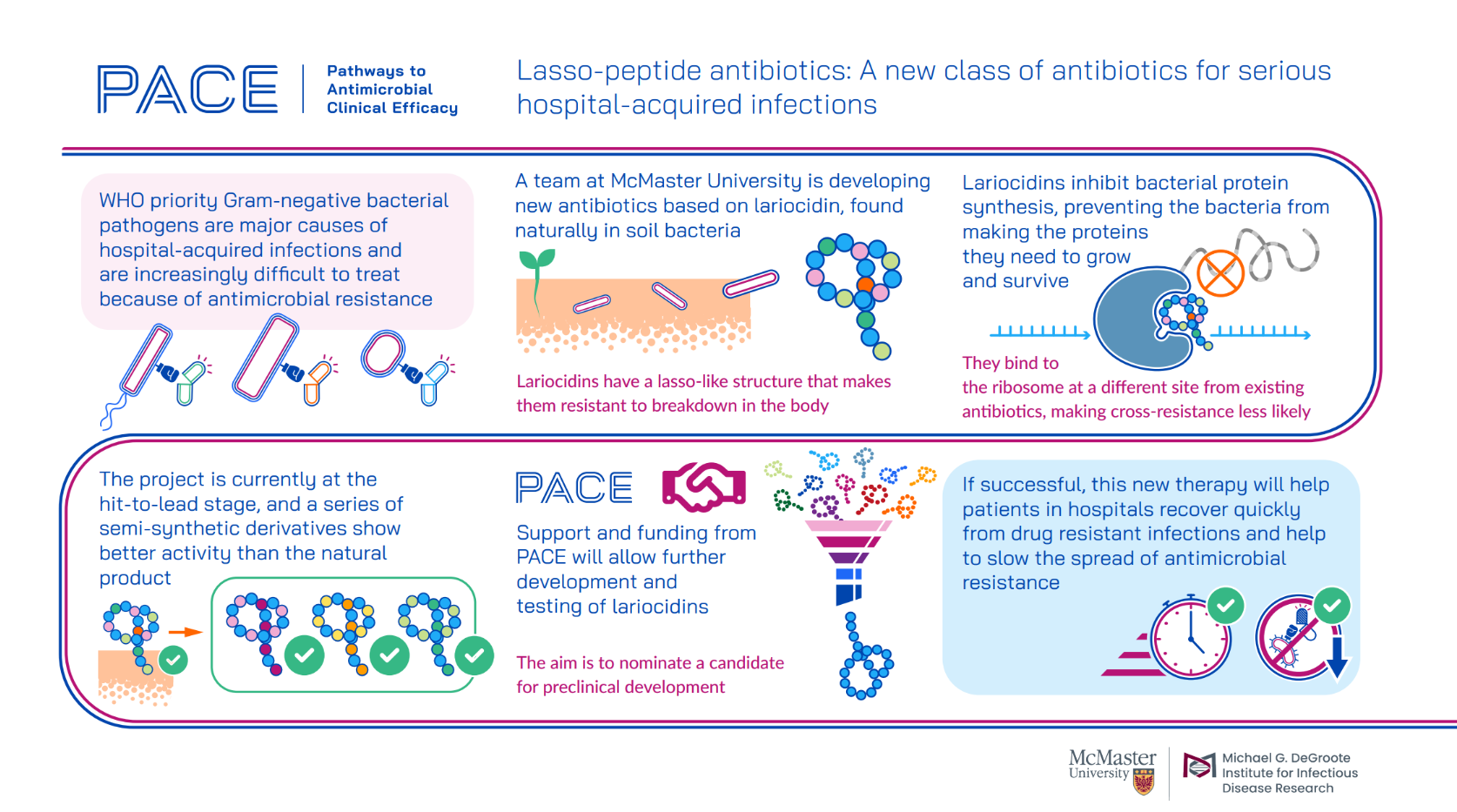
Hospital-acquired lower respiratory tract and bloodstream infections caused by WHO-priority Gram-negative bacterial pathogens are increasingly insensitive to standard-of-care antibiotics due to resistance.
To tackle this challenge, the Wright laboratory at McMaster University is developing a new class of lasso-peptide antibiotics based on lariocidin, a natural product obtained from soil bacteria. Lariocidins bind to the ribosome and inhibit bacterial protein synthesis, preventing the bacteria from making the proteins they need to grow and survive. They bind to a novel site on the ribosome, reducing the risk that bacteria will already have developed resistance to them through exposure to other ribosome-binding antibiotics. Lariocidins also have a unique knot-like molecular structure that makes them resistant to breakdown in the body, increasing the likelihood that they will remain active for long enough to reach the site of infection. Preliminary studies have shown promising results, supporting further investigation in in vivo models.
The project is currently at an advanced hit-to-lead stage, with lariocidin derivatives showing improved antibacterial activity compared to the original natural product. With funding and support from PACE, the team will develop the lariocidins further, investigating structure–activity relationships and carrying out de-risking studies to look more closely at in vivo efficacy, tolerability and safety. The aim is to nominate a candidate for preclinical development.
Success for the project will bring the new therapy one step closer to the clinic as a potential treatment for patients with severe drug-resistant infections. Ultimately, it could reduce reliance on last-line antibiotics that are increasingly compromised by resistance, and improve care for patients, particularly those with serious hospital-acquired infections.
Company summary
The Michael G. DeGroote Institute for Infectious Disease Research is based at McMaster University in Hamilton, Canada. It is a world-leading centre for interdisciplinary infectious disease research, where scientists are committed to delivering new knowledge and solutions to some of the most pressing challenges in infectious disease, including antibiotic resistance. Members span a variety of disciplines ranging from medicine and biochemistry to mathematics, anthropology, and engineering. Through collaborative research that spans the lab and the clinic, the institute is dedicated to finding new treatments and preventions to control infections that have devastating impacts on health.