

Oxepanoprolinamides: Next-generation lincosamide antibiotics for treating serious Gram-negative infections
Project title: Development of oxepanoprolinamides for the treatment of Gram-negative bacterial infections
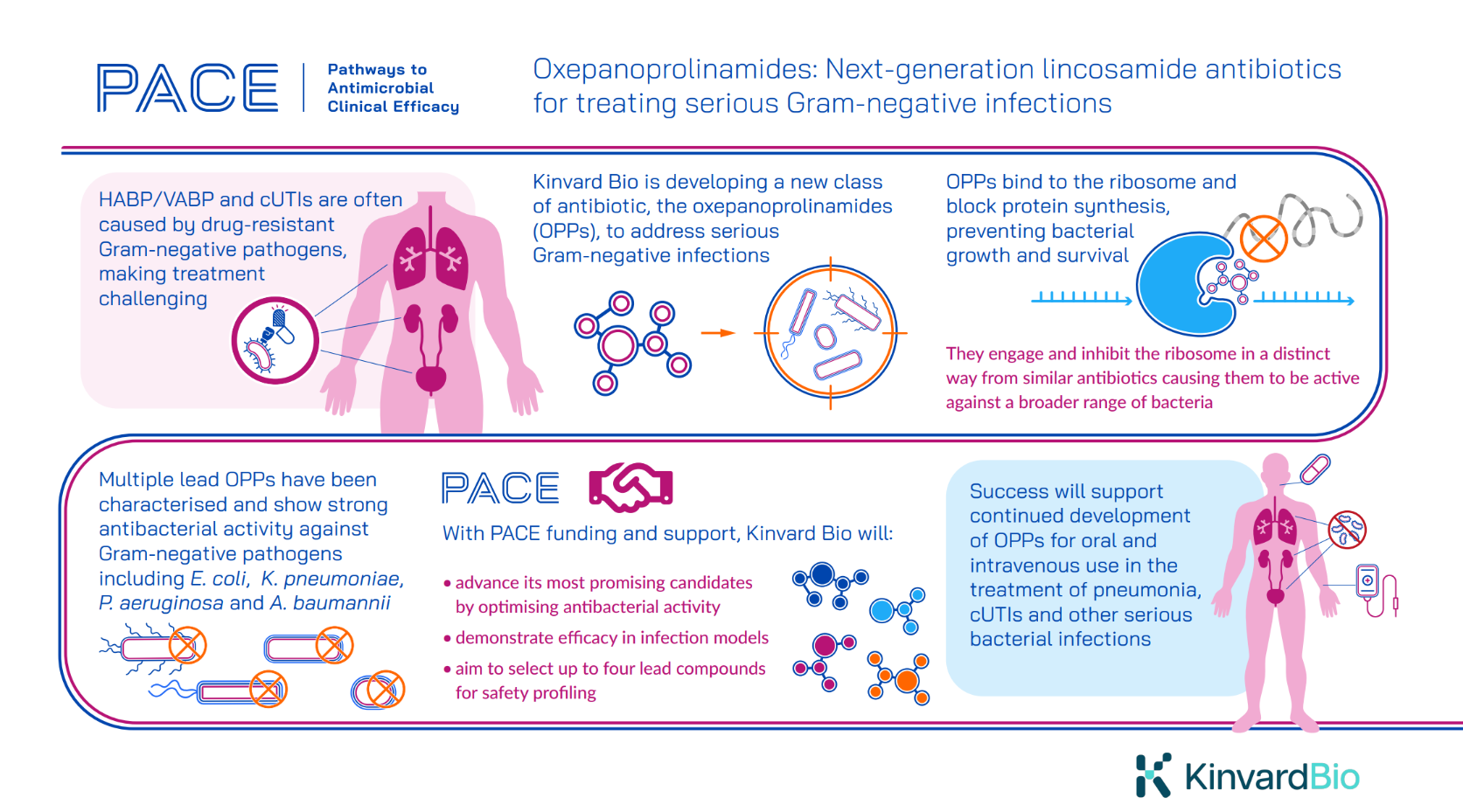
Hospital-acquired and ventilator-associated bacterial pneumonia (HABP/VABP) can be associated with mortality rates of up to 50% [1], often due to antimicrobial resistance. Meanwhile, around 13% of hospitalised patients with complicated urinary tract infections (cUTIs) are reported as having pathogens resistant to at least three major antibiotic classes [2]. HABP/VABP and cUTIs are often caused by Gram-negative drug-resistant pathogens, and treatment can be challenging.
To address this, Kinvard Bio is developing next-generation lincosamide antibiotics, the oxepanoprolinamides (OPPs). These interfere with protein production by binding to the catalytic centre of the bacterial ribosome, preventing bacteria from growing and surviving. While currently available lincosamides are primarily active against Gram-positive bacteria, OPPs bind to the ribosome in a distinct way that extends their spectrum of activity to include Gram-negative pathogens.
Kinvard Bio currently have multiple lead OPPs demonstrating high-affinity binding to the target site and potent antibacterial activity against Escherichia coli, Klebsiella pneumoniae, Acinetobacter baumannii and Pseudomonas aeruginosa. In preliminary studies, these compounds demonstrate a favourable safety profile, promising in vivo efficacy across infection models and encouraging oral bioavailability. With funding and support from PACE, the team will further optimise lead OPPs, define which Gram-negative pathogens and infections they are best suited to treat, and assess their antibacterial activity, safety, how they behave in the body and their efficacy in relevant in vivo infection models. The aim is to identify up to four compounds to progress into the next stage of candidate selection.
Success for the project will enable Kinvard Bio to advance the development of their antibiotic to treat HABP/VABP, cUTIs and other serious Gram-negative infections, sparing the use of ‘last-resort’ antibiotics. The new antibiotics are expected to be suitable for both intravenous and oral use, allowing hospitals to better manage patient discharge.
[1] H. Erdem et al., European Journal of Clinical Microbiology & Infectious Diseases, 2020, 39: 45–52. DOI: 10.1007/s10096-019-03691-z.
[2] M.D. Zilberberg et al., BMC Infectious Diseases, 2021, 21: 159. DOI: 10.1186/s12879-021-05842-0.
Company summary
Kinvard Bio, a spin-out from the prestigious Myers Lab at Harvard University’s Department of Chemistry and Chemical Biology, is pioneering the development of a new and differentiated class of ribosome-targeting antibacterials known as oxepanoprolinamides (OPPs).
With a focus on addressing the highest unmet patient need and commercial potential, Kinvard Bio’s OPP class of antibacterials presents substantial therapeutic potential across multiple clinical indications.
OPPs feature a unique molecular structure that ensures optimal binding within a specific site of the bacterial ribosome. This results in potent, broad-spectrum antibacterial activity, both in vitro and in vivo, while effectively bypassing a wide range of pre-existing resistance mechanisms.
Designed for both intravenous and oral routes of administration, our OPPs offer versatile treatment options for a range of acute and chronic bacterial infections.