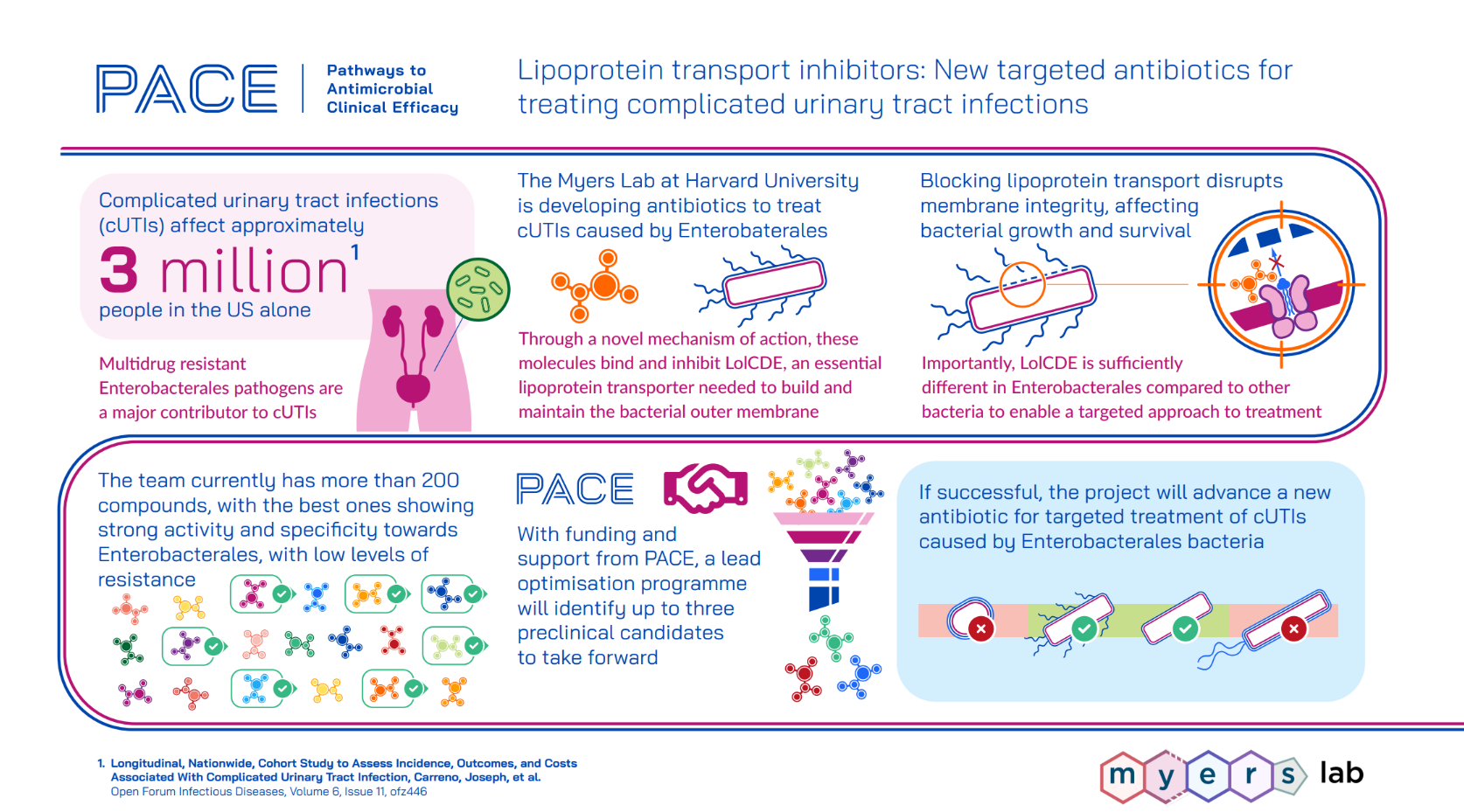
Lipoprotein transport inhibitors: New targeted antibiotics for treating complicated urinary tract infections
Project title: Lipoprotein transport inhibitors as antibiotics for MDR Enterobacterales
Antibiotic-resistant Enterobacterales pathogens are major contributors to complicated urinary tract infections (cUTIs). Extended-spectrum beta-lactamase-producing and carbapenem-resistant Enterobacterales (ESBL-CRE) strains are particularly problematic and are associated with substantial morbidity, mortality and healthcare costs [1,2].
The Andrew Myers Laboratory at Harvard University is addressing this challenge by developing new inhibitors targeting LolCDE, a protein complex involved in transporting lipoproteins to the outer bacterial membrane. Inhibiting LolCDE function disrupts membrane integrity, killing the bacteria. Importantly, differences in LolCDE between bacterial groups offer opportunities for targeted treatment of multidrug-resistant Enterobacterales, while also helping to limit effects on beneficial bacteria, particularly in the gut microbiome.
The team have so far synthesised over 200 related compounds and have identified how changes to their chemical structure improve their activity. The best compounds show high potency against and specificity for Enterobacterales, and initial experiments indicate that resistance arises at a very low frequency. With funding and support from PACE, the team will design and test new variations of the most promising compounds, with the aim of optimising their antibacterial activity and drug-like potential. The strongest leads will then undergo more detailed profiling, including pharmacokinetic and efficacy studies in relevant infection models, with the aim of identifying up to three candidates suitable for preclinical development.
If successful, the project will advance a new narrow-spectrum antibiotic for the treatment of cUTIs caused by multidrug-resistant Enterobacterales pathogens, including ESBL-CRE. This will provide a much-needed treatment option, helping to reduce patient suffering. Furthermore, since the antibiotic will act on a different target and through a different mechanism from existing classes, it is also unlikely to contribute to broader antimicrobial cross-resistance.
[1] M.D. Zilberberg et al., BMC Infectious Diseases, 2017, 17: 279. DOI: 10.1186/s12879-017-2383-z.
[2] S.H. MacVane, L.O. Tuttle and D.P. Nicolau, Journal of Hospital Medicine, 2014, 9: 232–238. DOI: 10.1002/jhm.2157.