

Optimising a fast, low-cost lateral flow test to improve diagnosis of lower respiratory tract infections
Project title: CLUE: Classification of LRTIs using expression markers
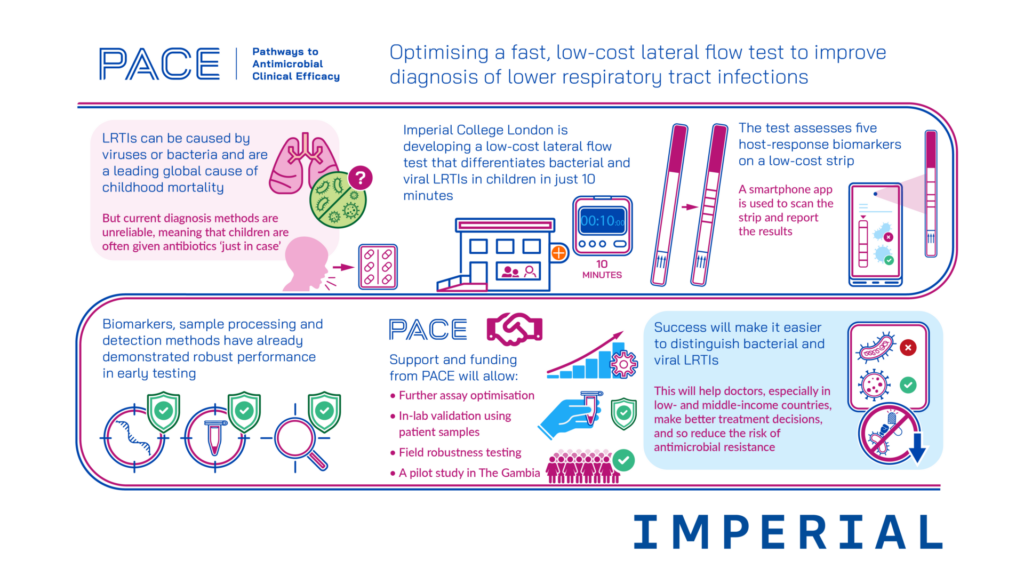
Lower respiratory tract infections (LRTIs) can be caused by viruses or bacteria, and are a leading cause of childhood mortality, especially in low- and middle-income countries. However, symptom-based diagnoses are unreliable, and sampling from the upper respiratory tract, as a proxy for LRTIs, is prone to inaccuracies. Children are therefore often given antibiotics ‘just in case’, increasing the risk of antimicrobial resistance.
To address this challenge, Imperial College London is developing a low-cost lateral flow test (MARPLE) that differentiates bacterial and viral LRTIs in children in just 10 minutes, without the need for a power source or expensive equipment. A drop of blood is placed on the strip, which assesses levels of five key mRNA host-response biomarkers. A smartphone app is then used to scan the strip and report the results.
Biomarkers for MARPLE have already been validated in transcriptomic datasets, and the novel sample processing and detection methodologies have shown promising performance in initial testing. Funding and support from PACE will enable further assay optimisation and stability testing in the field to demonstrate accuracy and stability in real-world conditions, with clinical validation using samples from children with LRTIs in The Gambia, Ghana and Nepal. A pilot study will then test MARPLE on children with fever in The Gambia to determine how accurate and reliable the test is.
Project success will mean accurate and rapid differentiation between bacterial and viral LRTIs, delivered in a way that is accessible to primary care settings in low- and middle-income countries. This will help doctors make faster and more informed treatment decisions and reduce the unnecessary prescription of antibiotics that contributes to antimicrobial resistance.
Company Summary
We are Imperial – a world-leading university for science, technology, engineering, medicine and business (STEMB), where scientific imagination leads to world-changing impact.
As a global top ten university in London, we use science to try to understand more of the universe and improve the lives of more people in it. Across our 10 campuses and throughout our Imperial Global network, our 22,000 students, 8,000 staff, and partners work together on scientific discovery, innovation and entrepreneurship. Their work navigates some of the world’s toughest challenges in global health, climate change, AI, business leadership and more.
Founded in 1907, Imperial’s future builds on a distinguished past, having pioneered penicillin, holography and fibre optics. Today, Imperial combines exceptional teaching, world-class facilities and a habit of interdisciplinary practice to unlock scientific imagination.