
Developing a rapid, low-cost breath test to improve diagnosis of community-acquired pneumonia
Project title: Point-of-care breath test to detect bacterial community-acquired pneumonia
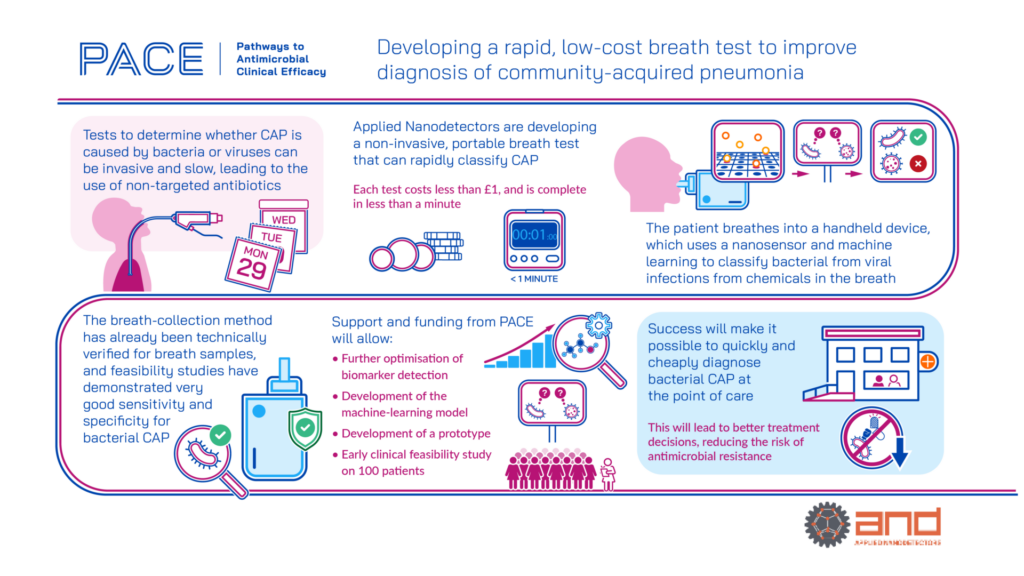
Chest infections, such as community-acquired pneumonia (CAP), can be caused by bacteria or viruses, but tests to determine the pathogen can be invasive and typically take 24–72 hours. This can lead to antibiotics being prescribed without a definite diagnosis, contributing to antimicrobial resistance.
To address this challenge, Applied Nanodetectors is developing a rapid, portable and non-invasive test that can identify bacterial CAP. The test involves breathing into a small handheld device, which uses an array of nanoscale sensors to identify the volatile organic compounds released by the body during an infection. Machine learning is then used to classify the infection as bacterial or viral, with the entire test completed in under a minute. Affordability is an important consideration, with the projected cost of each breath test being less than £1.
The breath-collection method has already been technically verified for breath samples, and initial biomarker feasibility studies have proved successful for bacterial CAP, demonstrating 90% sensitivity and 85–90% specificity. With funding and support from PACE, Applied Nanodetectors will further optimise CAP biomarker detection and develop the machine-learning model and prototype device. The project will conclude with pre-clinical studies involving 100 patients across three GP sites in the UK.
Success for the project will lead to a rapid, non-invasive, low-cost breath test for CAP that can be used at the point of care both in the UK and globally. Patients will benefit from improved treatment decisions, which will help address the growing challenge of antimicrobial resistance.
Company Summary
Applied Nanodetectors is a leading developer and supplier of nanosensor-based solutions for environmental and industrial markets. We specialise in the development of intelligent sensing systems that detect and interpret gases and volatile organic compounds (VOCs) in air and breath using nanotechnology and embedded AI.